
If you want to know how to build a 4×8 raised garden bed without blowing your budget, here’s the short version: three 8-foot 2×12 boards, a short 4×4 post for the corners, one 2×4 for a center brace and a box of exterior screws make a sturdy frame in an afternoon. That one-board-tall bed holds about 27 cubic feet of soil, which is roughly one cubic yard.
The frame is the cheap part. The real money goes into the soil, so the budget wins come from buying soil in bulk instead of in bags, picking the right depth for what you grow, and filling the bottom of taller beds with free woody material. Below you’ll find the cut list, step-by-step build, exact soil math and the mistakes we see most often.
Quick Summary / Key Takeaways
- Size: 4 feet wide lets you reach the middle from either side without stepping in; 8 feet long gives you 32 square feet of growing space.
- Materials (one tier): three 2x12x8 boards, one 4×4 post, one 2x4x8 and 3-inch exterior-rated screws.
- Soil needed: about 27 cubic feet (1 cubic yard) for one 2×12 tier; about 54 cubic feet (2 cubic yards) for two tiers.
- Best mix: about 70% topsoil and 30% finished compost, a solid, widely used mix for vegetables.
- Site: at least 6 to 8 hours of direct sun, level ground and a hose within easy reach.
- Skip: gravel in the bottom, plastic under the bed and old railroad ties.
What You Need to Build a 4×8 Raised Garden Bed
Most home centers sell 2×12 boards in 8-foot lengths, which is exactly why 4×8 is such a popular size. Remember that lumber is sold by its nominal size: a 2×12 actually measures about 1½ by 11¼ inches, and a 4×4 measures about 3½ by 3½ inches.
Shopping list for one tier (11¼ inches deep)
- 3 boards, 2×12, 8 feet long (two stay whole for the sides, one gets cut into two 45-inch ends)
- 1 post, 4×4, any length of at least 4 feet (cut into four 11¼-inch corner blocks)
- 1 board, 2×4, 8 feet long (one 45-inch center brace, with plenty left over)
- About 40 exterior-rated 3-inch screws (coated deck screws or structural screws)
- Optional: ¼-inch hardware cloth if gophers or voles are a problem in your yard
- Tools: tape measure, speed square, circular saw (or have the store make your cuts), drill/driver, level and a shovel
Which wood should you use?
This is the question every new builder asks, and the tradeoffs are pretty clear. You don’t need fancy lumber, but you should know the tradeoffs.
| Material | Cost | Durability | What the experts say |
|---|---|---|---|
| Untreated pine, spruce or fir | Lowest | Shortest-lived; rots fastest in wet soil | Untreated SPF lumber costs less than pressure-treated wood. |
| Cedar or redwood | Higher | Naturally decay-resistant | Both are naturally decay-resistant choices. |
| Modern pressure-treated (MCA, CA or ACQ) | Moderate | Long-lasting | Copper rose only slightly, within about 1 inch of the board, with no increase in the vegetables tested. |
| Old CCA-treated wood, railroad ties | Often free | Varies | Avoid. CCA was phased out for residential use around 2004, and railroad ties are treated with industrial preservatives not meant for gardens. |
| Galvanized steel kits | Moderate to high | Long-lasting | A good option; steel beds drain well with no extra drainage layer. |
Our neighborly advice: if you want the cheapest build, use untreated pine and plan to replace it someday. If you want to build it once, cedar or modern pressure-treated lumber is worth the extra cost. If treated wood still makes you uneasy, paint or stain it, or choose stone or brick.
Pick the Right Spot First
A perfect bed in the wrong place will still struggle. Most vegetables need a minimum of 6 to 8 hours of direct sun, and raised beds need regular watering because they dry out faster than in-ground gardens.
- Sun: Watch the spot for a full day. Morning sun with afternoon shade can work for lettuce and greens, but tomatoes, peppers and squash want the full 6 to 8 hours.
- Water: Put the bed within reach of a hose. You’ll water it far more often than you think in July.
- Level ground: A level site keeps water from running off one end and keeps the frame from racking.
- Access: Leave about 2 feet of path around the bed for a wheelbarrow and your knees.
- Width check: 4 feet is a convenient width because you can reach the center from either side. If one long side sits against a fence, go no wider than 2 to 2½ feet instead.
Step-by-Step: How to Build a 4×8 Raised Garden Bed
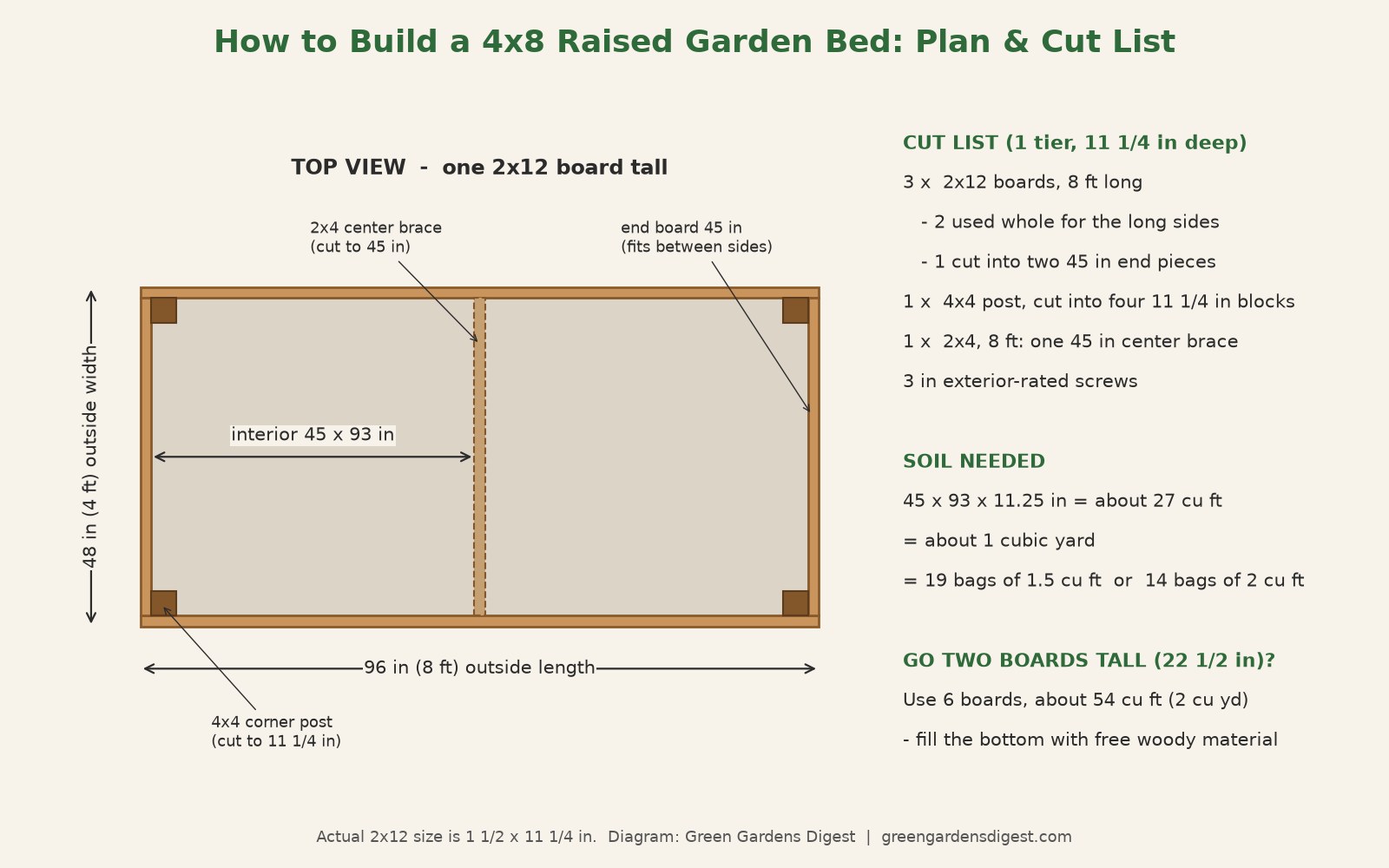
- Make your cuts. Cut one 2×12 in half to get two 45-inch end boards (you’ll have a small offcut left). Cut four 11¼-inch blocks from the 4×4 for the corners, and one 45-inch piece from the 2×4 for the center brace. Many home centers will make simple cuts for you.
- Build the two ends first. Stand a 4×4 block at each end of a 45-inch board, flush with the top and the outer edge. Drive three screws through the board into each block. Repeat for the other end.
- Attach the long sides. Set the two ends upright 8 feet apart. Lay an 8-foot side board against them so it covers the end grain of the end boards, then drive three screws into each corner block. Add the second side the same way. The outside of your frame is now 48 by 96 inches.
- Square it up. Measure both diagonals corner to corner. When the two numbers match, the frame is square. Nudge it until they do.
- Add the center brace. Screw the 45-inch 2×4 between the two long sides at the 4-foot mark, flush with the top edge. A middle brace matters on any bed longer than 4 feet, because the weight of wet soil pushes long boards outward over time.
- Prep the ground. Slice off sod or pull weeds, then loosen the soil underneath by pushing a garden fork in and rocking it back and forth every 6 to 8 inches. You’re loosening it, not flipping it.
- Add a critter barrier if needed. In gopher or vole country, staple ¼-inch hardware cloth across the bottom of the frame before you set it in place. This is a necessity where gophers are a problem.
- Set and level the frame. Place the bed, check it with a level both ways, and dig the high side down rather than shimming the low side up.
Want it taller?
For a bed about 22½ inches deep, build two identical frames and stack them, or use 4×4 posts long enough (about 22½ inches) to catch both rows of boards. That doubles the lumber to six 2x12s, and it also doubles the soil you need. It’s easier on your back, but it’s the most expensive way to go unless you use the budget fill method below.
How Deep Should a 4×8 Raised Bed Be?
On open ground, roots can grow right down into the native soil beneath the bed, so you don’t need a huge box. Aim for at least 1 foot of depth; 6 to 12 inches of soil is a solid range. A single 2×12 tier lands right in that sweet spot.
The rules change on a patio or driveway, where roots can’t go any deeper than the box. For beds on hard surfaces, use at least 8 inches for leafy greens, beans and cucumbers, and 12 to 24 inches for peppers, tomatoes and squash.
| Where the bed sits | What you’ll grow | Suggested depth | Build |
|---|---|---|---|
| Open, loosened ground | Most vegetables | About 12 inches | One 2×12 tier |
| Hard surface (patio, driveway) | Lettuce, greens, beans, cucumbers | 8 inches minimum | One 2×12 tier |
| Hard surface (patio, driveway) | Tomatoes, peppers, squash | 12 to 24 inches | Two 2×12 tiers |
| Anywhere, gardener has back or knee issues | Anything | 22½ inches or taller | Two tiers plus budget fill |
How Much Soil Does a 4×8 Raised Bed Need?
Here’s where budgets get blown, so let’s do the math once. Because the end boards sit inside the sides, the inside of a one-tier bed is about 45 by 93 inches and 11¼ inches deep.
- 45 × 93 × 11.25 = about 47,080 cubic inches
- Divide by 1,728 (cubic inches per cubic foot) = about 27 cubic feet
- Divide by 27 (cubic feet per cubic yard) = about 1 cubic yard
- In bags: about 19 bags of 1.5 cubic feet, or 14 bags of 2 cubic feet
- Two tiers (22½ inches deep): about 54 cubic feet, or 2 cubic yards
Soil settles after the first few waterings, so plan on topping up with a little extra. For exact bag counts at any depth from 8 to 24 inches, see our how many bags of soil for a 4×8 raised bed chart. And before you buy 19 bags, call a local landscape supply yard and ask their price for one cubic yard of a topsoil and compost blend. Since one cubic yard equals 18 bags of 1.5 cubic feet, it’s easy to compare the per-bag price against the bulk price yourself.
The Best Soil Mix for a 4×8 Raised Bed
You don’t need a secret recipe. The basics are simple: mostly good topsoil, plus a generous amount of finished compost.
| Mix (by volume) | Amounts for one tier (27 cu ft) |
|---|---|
| 70% topsoil + 30% compost | About 19 cu ft topsoil + 8 cu ft compost |
| 2 parts topsoil + 1 part compost (or 1:1) | About 18 cu ft topsoil + 9 cu ft compost |
| Equal parts topsoil, compost and coarse sand | About 9 cu ft of each |
Two quality checks matter more than the exact ratio. Brought-in topsoil should be free of soil-borne diseases and contaminants like lead or pesticides, and compost should be fully finished. If you’re unsure about your soil, a soil test tells you pH and nutrients before you plant.
One more tip: mix the first few inches of your new soil into the loosened ground below instead of dumping it on top in a distinct layer. Sharp layers between soil types slow water and discourage roots.
Cheap Way to Fill a Raised Garden Bed (Hugelkultur-Style)
If you built a two-tier bed, you don’t have to fill all 54 cubic feet with purchased soil. Our guide to the cheapest way to fill a raised garden bed has exact wood-layer depths for beds from 12 to 30 inches tall. A hügelkultur approach for raised beds uses logs, limbs and leaves to cut down on the soil and compost needed for deep beds.
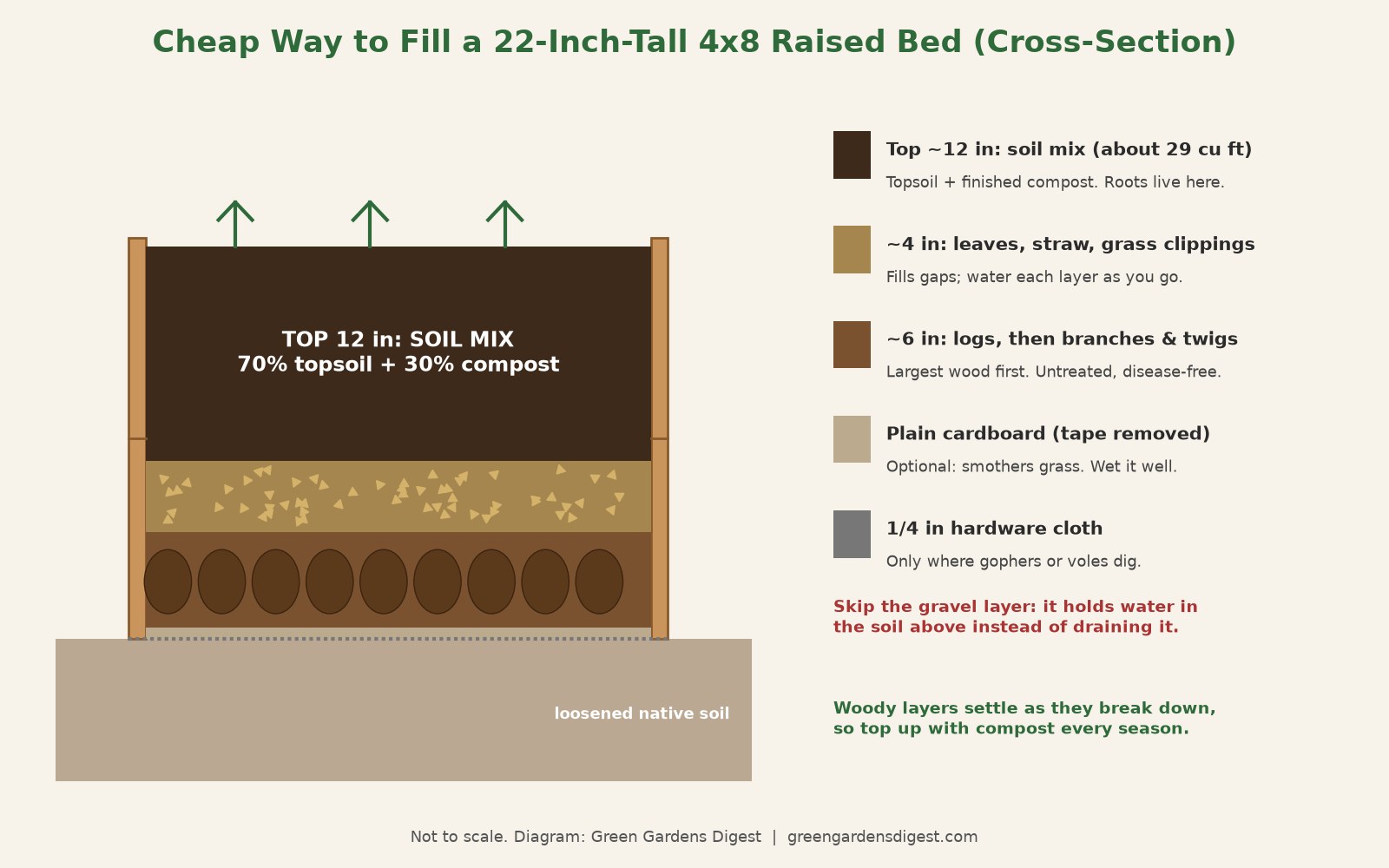
- Optional cardboard: Lay plain brown cardboard (tape and labels removed) on the ground to smother grass, and soak it. A 3- to 4-inch layer of corrugated cardboard works well in hügelkultur beds.
- Wood, biggest first: Add about 6 inches of logs, then branches, then twigs. Use untreated, disease-free wood, and skip diseased trees or leaves.
- Soft layer: Pack about 4 inches of fallen leaves, straw or untreated grass clippings into the gaps. Water every layer as you go.
- Real soil on top: Finish with about 12 inches of your topsoil and compost mix. That’s roughly 29 cubic feet, so the woody base replaces around 25 cubic feet of soil you’d otherwise buy.
Be honest with yourself about the tradeoffs. Woody material settles as it breaks down, so plan on adding more compost over time to keep the bed full. Logs and branches can also create air pockets and settling, especially in freeze-thaw climates. For a single 11¼-inch tier, we’d skip the logs entirely and just fill it with good soil mix, since there isn’t enough depth to spare.
Common Mistakes to Avoid
- Adding gravel “for drainage.” Gravel under soil creates a perched water table, which holds water in the soil above it. Don’t add it.
- Putting plastic under the bed. Plastic on the bottom prevents drainage. On a patio, landscape fabric is the better liner.
- Skipping the center brace. An 8-foot side full of wet soil will bow outward. One 2×4 brace prevents it.
- Building it too wide. If you can’t reach the middle, you’ll step in and compact the soil. Stick to 4 feet or less.
- Using mystery fill dirt. Free soil can bring weeds, debris or contaminants. Know where your topsoil came from.
- Unfinished compost. Material that is still breaking down can tie up nitrogen your plants need. Use dark, crumbly, finished compost.
- Reusing old lumber blindly. Lumber more than 20 years old may be CCA-treated, and manufacturers don’t recommend CCA wood for garden beds.
What to Plant in Your New Bed
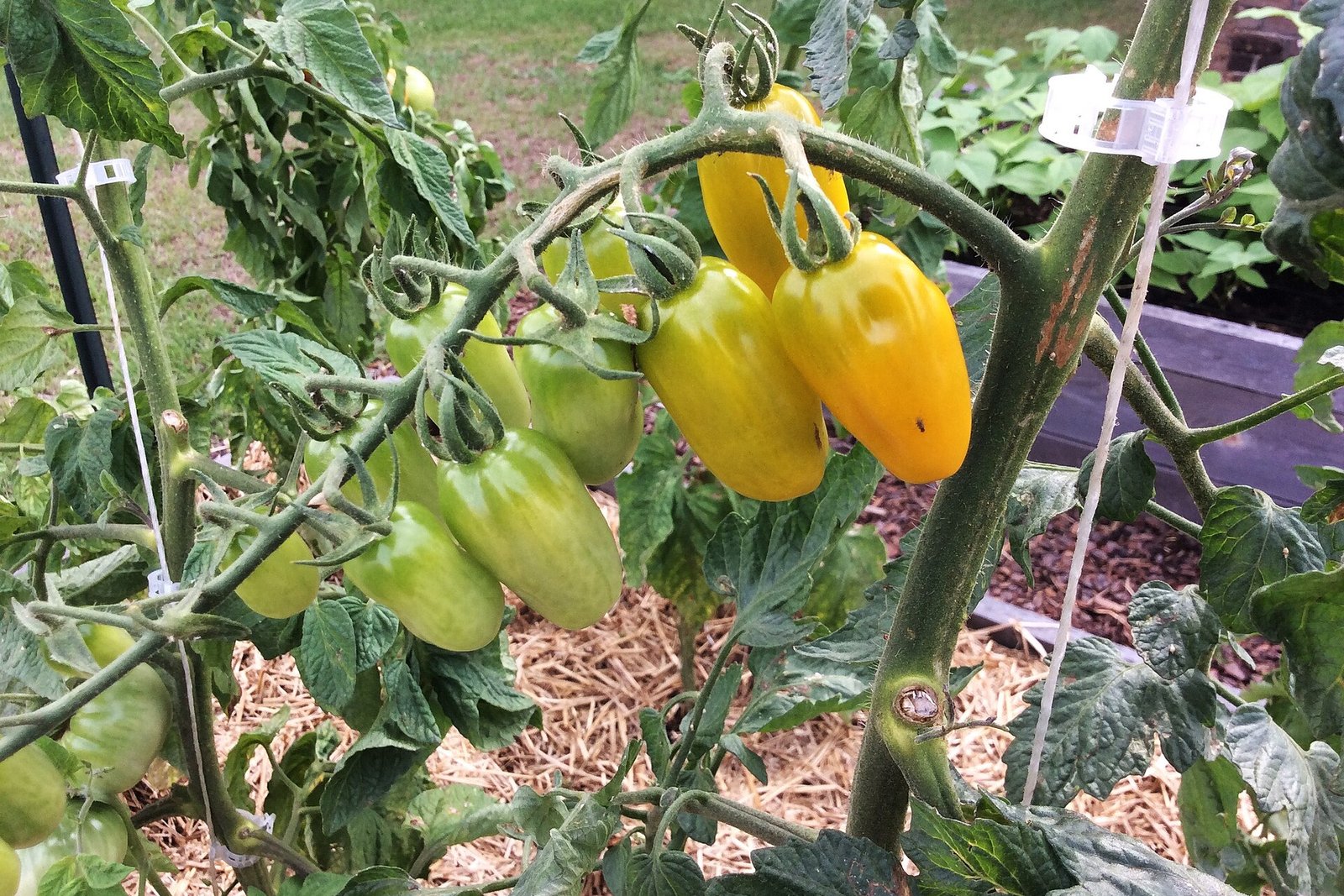
A fresh 4×8 bed gives you 32 square feet to work with. A few easy, productive first crops:
- Cool season: lettuce, spinach, kale, cabbage, radishes and carrots
- Warm season: tomatoes, peppers, bush beans, cucumbers and summer squash
- Herbs and helpers: basil, parsley, and flowers like marigolds or nasturtiums, which make good companion plants
Once it’s planted, mulch the soil surface with a layer of straw or shredded leaves. Mulching raised beds conserves moisture and controls weeds, and you’ll water far less in summer.
Frequently Asked Questions
How many bags of soil do I need for a 4×8 raised bed?
For one 2×12 tier (about 11¼ inches deep), you need about 27 cubic feet: roughly 19 bags of 1.5 cubic feet or 14 bags of 2 cubic feet. For a bed filled a full 12 inches deep, it’s 32 cubic feet if you measure the outside dimensions.
What is the cheapest way to fill a raised garden bed?
Buy topsoil and compost by the cubic yard from a local supplier, and for beds deeper than about 18 inches, fill the bottom with untreated logs, branches and leaves before topping with about 12 inches of real soil mix.
What should I put in the bottom of a raised garden bed?
On open ground, usually nothing but loosened native soil. Add ¼-inch hardware cloth if burrowing animals are a problem, and plain cardboard if you’re building over grass. Skip gravel and plastic.
Is pressure-treated wood safe for a vegetable raised bed?
Modern residential pressure-treated lumber (MCA, CA or ACQ) does not contain arsenic. There’s no increase in copper in vegetables grown in copper azole-treated beds. If you’d rather avoid it, use cedar, redwood, stone or steel.
How long does it take to build a 4×8 raised bed?
With your cuts made, assembling the frame takes most beginners an afternoon. Filling it takes longer, mostly because you’re moving about a cubic yard of soil by wheelbarrow.